
This article is written by Komal Verma, one of the best AI Digital Marketing Experts with experience in AI-driven strategies and digital growth.
More people are asking AI tools for advice instead of typing into Google. If your business does not show up when they ask, you lose the sale before you even know the customer was looking.
AI search optimization is the practice of shaping your online presence so tools like ChatGPT, Gemini, and Perplexity mention your business when someone asks a related question. This guide shows you how to do it, step by step, in plain language. No jargon. No guesswork.
What Is AI Search Optimization (and Why It Matters Now)
AI search optimization is not the same as ranking on a search results page. There is no page to rank on anymore. Instead, an AI tool reads a question, searches its training data or the live web, and writes an answer in its own words. Your job is to make sure your business becomes part of that answer.
This matters more every year. Gartner predicts that 25% of all organic search traffic will move from search engines to AI chatbots and assistants by the end of 2026. ChatGPT alone answers over 2 billion questions every day. Visits to websites coming from AI tools grew 527% year over year through mid-2025.
Customers are already asking AI tools for recommendations. The only question left is whether your business is part of the answer they get.
AEO vs. GEO vs. Traditional SEO – What’s the Difference?
These three terms get used together, but they are not the same thing.
| Term | What it means | What it optimizes for |
|---|---|---|
| SEO (Search Engine Optimization) | Getting your page to rank high in Google or Bing results | Clicks from a results page |
| AEO (Answer Engine Optimization) | Structuring content so it can be pulled out and used as a direct answer | A clear, quotable answer |
| GEO (Generative Engine Optimization) | Getting an AI model to mention or recommend your brand by name | Brand visibility inside an AI-written response |
You do not have to pick just one. Strong AI search optimization uses all three together: solid SEO as the foundation, AEO for structure, and GEO for brand visibility inside the final answer.
How ChatGPT, Gemini, and Perplexity Actually Choose Which Brands to Mention
Each AI tool decides differently. Knowing the difference tells you exactly where to spend your time and effort.
ChatGPT mostly relies on what it learned during training. It has read millions of articles, and it remembers which brands got mentioned again and again next to certain topics. If your business name has not appeared often, in trusted places, next to the right words, ChatGPT has little reason to recall it when someone asks a related question. Around 41% of ChatGPT’s brand recommendations trace back to the brand appearing on authoritative “best of” or “top” lists somewhere on the web.
Perplexity works differently. It searches the live web for every answer instead of relying only on memory, so it can find newer content that ChatGPT has not “learned” yet. Community platforms like Reddit and Quora make up close to 46.7% of Perplexity’s top-cited sources. If your customers are already talking about your business on Reddit, Perplexity is very likely to notice.
Gemini sits closer to traditional Google Search. It leans on Google’s search index, structured data on your website, and Google Business Profile signals. This means the SEO work you already do still carries real weight here.
Here is the part most guides skip: none of the three lean much on backlinks or keyword density, the classic SEO signals from the last decade. What they care about is what is written about your brand, in what words, how often, and how consistently across the web.
The 5-Step AI Visibility Framework
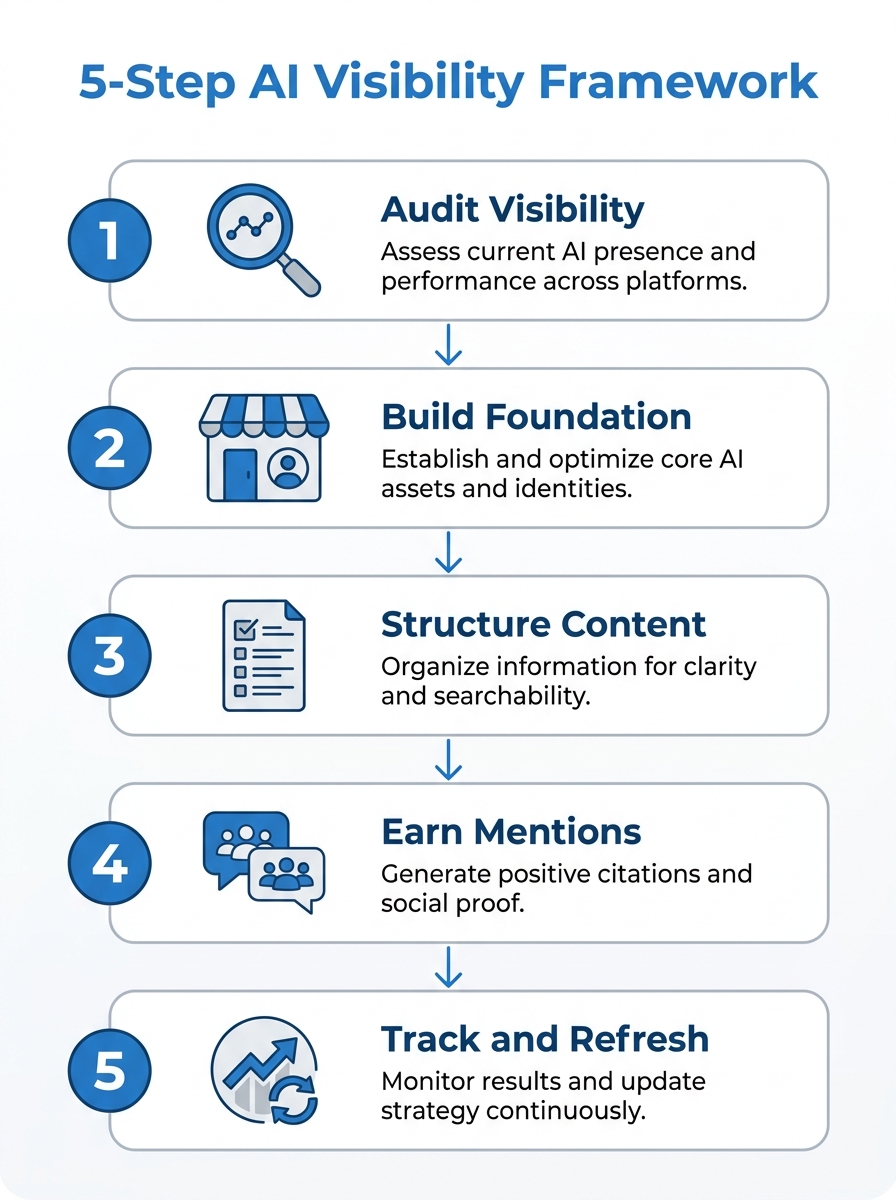
Use this simple AI search optimization framework to go from invisible to mentioned. Each step builds on the one before it.
Step 1: Audit Your Current AI Search Visibility
Before you fix anything, find out where you actually stand today.
Open ChatGPT, Gemini, and Perplexity. Ask 10 to 15 real questions your customers might type – category questions, comparison questions, and problem questions. For example, if you sell accounting software, try “What is the best accounting software for freelancers?”
Write down whether your business appears, and in what context, if it does. This becomes your baseline. Free tools such as Semrush’s AI Search Visibility Checker can also give you a quick starting snapshot without manual testing.
Step 2: Build Your Foundation (Business Profile & Third-Party Trust)
AI tools trust third-party proof more than they trust your own website copy. Anyone can write nice things about themselves. Reviews and profiles are harder to fake at scale.
- Complete your Google Business Profile fully. Fill in your category, description, hours, photos, and the Q&A section. This is one of the single highest-leverage steps you can take, especially if you serve local customers.
- Collect real reviews. Set up a profile on Trustpilot and invite actual customers to leave feedback. Verified reviews build exactly the kind of trust signal AI tools are trained to look for.
- Claim relevant directory listings. Yelp, Clutch, and industry-specific directories are used by Perplexity as trusted sources. If you are not listed there, that entire path to visibility is closed to you.
Step 3: Structure Your Website Content for AI Extraction
AI tools pull answers out of pages that make the answer easy to find and easy to lift out.
- Answer first, explain second. Put the direct answer to a question in the first sentence or two of a section. Add the explanation and context after, not before.
- Use FAQ and Organization schema. Structured data (JSON-LD code) tells AI crawlers exactly which text is a question and which text is the answer. Start with Organization schema on your homepage, then add FAQPage schema to your most important content pages.
- Consider an llms.txt file. This is a simple text file at your site’s root that lists your most important pages for AI systems to read, similar to a sitemap built for AI instead of search engines. It is still a new standard with limited adoption, so treat schema markup as your priority and llms.txt as a bonus, not a requirement.
Step 4: Earn Real Mentions Where AI Actually Looks (Reddit, Quora, Forums)
This step surprises most business owners, but it may matter more than anything on your own website.
Reddit is the single most-cited source across major AI search engines combined. A helpful, honest comment on a relevant thread can get picked up by Perplexity within 24 hours of posting. Engagement does not decide visibility here – most cited Reddit posts have fewer than 20 upvotes and 20 comments. What matters is that the comment is specific, timely, and reads like a genuine answer from a real person, not a sales pitch.
Expect 60 to 120 days between your first genuine community post and your first AI citation. This is a patience game, built through consistency, not a one-time task you check off a list.
Step 5: Track Your Progress and Keep Content Fresh
AI search optimization is not “set and forget.” It needs ongoing attention, the same way SEO does.
Track these over time:
- How often your brand is mentioned across ChatGPT, Gemini, and Perplexity
- Which specific pages or posts are being cited as sources
- Your share of voice compared to competitors in your category
Freshness matters just as much as the content itself. For commercial and evaluation-stage questions, 83% of AI citations came from pages updated within the past 12 months, and more than 60% were refreshed within the last six months. A page that was once accurate but has not been touched in two years quietly falls out of the answer pool, even if nothing on it is technically wrong.
Common Mistakes That Keep Businesses Invisible in AI Search
These AI search optimization mistakes keep otherwise good businesses invisible in AI-generated answers.
- Optimizing for short keywords instead of real questions. Long, specific searches of 10 or more words trigger AI summaries about 53% of the time, compared to just 8% for short searches. Write for the full question a customer actually asks, not a three-word keyword.
- Publishing AI-written content with no real expertise inside it. AI models are trained on the same web content they are now competing to summarize, so they can spot content that just repeats what is already out there. Add your own experience and specific detail that only you could write.
- Skipping structure. Long walls of text with no headings, short answers, or lists are much harder for an AI system to extract a clean answer from.
- Ignoring measurement. Without a baseline and a way to check progress, you have no way to know if any of this work is actually helping.
FAQs
What is AI search optimization?
AI search optimization is the work of shaping your online presence – your website, reviews, profiles, and community mentions – so AI tools like ChatGPT, Gemini, and Perplexity mention your business inside their answers.
How does ChatGPT decide which brands to mention?
ChatGPT recalls brands it learned about during training, based on how often and how consistently they were mentioned in trusted, relevant content across the web. Backlinks and keyword density have little effect on this.
Is AEO different from SEO?
Yes. SEO aims to rank a page on a search results list. AEO structures content so an AI tool can pull out a clear, direct answer from it. The two work best together, not as replacements for each other.
Do I need schema markup to show up in AI search?
It is not strictly required, but it helps a great deal. FAQ and Organization schema make it far easier for AI crawlers to understand your content and use it as a trusted source.
How long does it take to get cited by ChatGPT or Perplexity?
Plan for 60 to 120 days for community-based citations, like Reddit mentions picked up by Perplexity. Foundational work, like schema markup and business profiles, tends to show results within about 90 days.
Can a small business compete with big brands in AI search?
Yes. Good AI search optimization rewards clear, specific, well-sourced answers more than it rewards size or ad budget. A small business that answers real customer questions well can out-perform a larger, vaguer competitor here.
Does Reddit actually help you get mentioned by AI?
Yes. Reddit is the most-cited source across major AI search engines combined. Genuine, specific comments on relevant threads have a real chance of being picked up, often within days of posting.
Conclusion
AI search optimization is not a trend you can afford to skip. It is quickly becoming a normal, everyday part of how customers find and choose businesses. Start with your foundation – your Google Business Profile, your reviews, and your website structure. Then build a real presence in the communities your customers already use, like Reddit and Quora. Track what happens, and keep your content fresh.
Want more practical, jargon-free guides like this one? Follow Digital With Komal for more on AI SEO, AEO, and digital marketing strategies that actually work.